AHA ACLS
Massachusetts General Hospital ISMedical
3.439.00 Reviews
- Version
- 3.2.0
- Installs
- 50.00K
- Age Rating
- Everyone
Screenshots
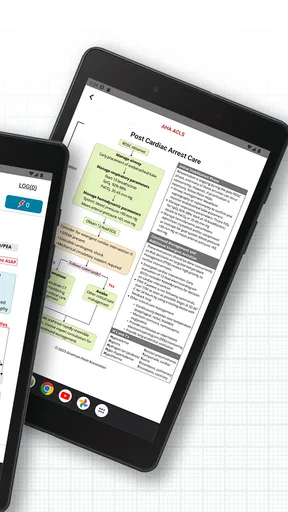
Our Review of AHA ACLS
 Analysis by Appyee
When I look at a medical reference app, I care less about bold promises than about whether I can find a relevant protocol quickly and then use it to study in a calm setting. AHA ACLS is aimed at advanced cardiac life support learning, so its strongest role is as a study companion for people who already have a reason to understand ACLS—not as a substitute for clinical training or emergency services. Its design and content can make review feel more convenient, but I would still treat it as one tool in a broader learning routine.
Finding Your Way Through ACLS Material
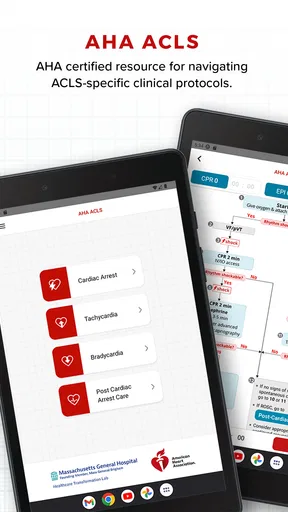
My first impression of the navigation is that it tries to put reference material and study activities in the same place. That can be useful when I want to move from reading an algorithm to checking whether I understand it, rather than switching between several separate resources. The app is a free medical app from Massachusetts General Hospital IS, and its focus is narrow enough that the subject is clear from the outset.
The interface is described as straightforward, but a clean layout only helps if the user already recognizes the terms they are looking for. Someone new to cardiac life support may still need a course, instructor, or textbook to explain the background behind a protocol. I would approach the app as a place to review and organize learning, not as a beginner’s replacement for structured teaching.
Reference Material and Study Rhythm
The algorithm and protocol library is the part I would expect to revisit most often. In a study session, I would choose one topic, read through its steps, and then use a quiz or practice test to see whether I can recall the sequence without simply scanning the page. That small change in routine makes the material more active: instead of treating a protocol as something to glance at, I can use it to identify where my understanding breaks down.
It is also worth separating recognition from recall. A diagram can look familiar while still being difficult to reproduce under pressure. I find it more useful to study a section, put the phone aside, and explain the order of actions in my own words before checking the reference again. The app’s quizzes can support that process, but they do not by themselves show that someone is ready to perform a procedure in a real clinical setting.
Reading Comfort, Motor Use, and Sensory Context
For readability, short focused sessions are a better fit than trying to absorb everything in one sitting. I would use the app in a quiet place first, where I can concentrate on the wording and distinguish one part of a protocol from another. If a reader has low vision, relies on enlarged text, or finds dense medical terminology tiring, the practical question is whether the device’s own display and accessibility settings make the material comfortable enough to study. I would test that before relying on it as a regular reference.
Motor access matters too. A person who has difficulty with precise taps may find any phone-based study tool frustrating if navigation depends on small targets or quick movement between screens. I would explore the interface at an unhurried pace and check whether the device’s built-in controls make it easier to move through content. I would not assume that a medical subject automatically means the app is optimized for every ability or input method.
Sound and attention are another consideration. A busy workplace, a noisy commute, or a shared room can make focused learning difficult, even when the material is on a phone. For that reason, I would use short review periods during quiet breaks rather than trying to learn an unfamiliar protocol while multitasking. A pocket reference may be convenient, but convenience does not remove the need to read carefully.
Offline Study and Practical Situations
Offline access is useful when I want to study somewhere with unreliable connectivity. A realistic use would be reviewing a topic during a commute or between appointments, then returning to the same material later in a more focused session. I would still check in advance that the content I need is available offline, rather than discovering a connectivity problem at the moment I want to study.
Bookmarks and reminders can help turn an occasional browse into a routine. One practical approach is to bookmark topics that felt uncertain after a quiz, then revisit only those sections during the next session. That is more manageable than repeatedly reading familiar material. If reminders become noise, though, I would rather set a modest schedule I can maintain than create frequent prompts that I eventually ignore.
Case scenarios can add a useful decision-making layer because they ask the learner to apply information rather than only read it. I would treat them as practice for organizing thought, not as a simulation that can reproduce the pressure, team communication, or physical actions of an actual emergency. The difference matters: an app can help me notice gaps in my reasoning, while supervised practice is needed for skills that involve people and equipment.
Where It Fits Alongside Other Learning Options
Compared with a printed ACLS handbook, a phone app is easier to carry and can put reference material and quizzes together. A handbook may be more comfortable for someone who prefers a larger page, wants to annotate extensively, or finds screen reading tiring. Compared with a course led by an instructor, the app is more flexible for brief review but cannot provide direct feedback on practical performance or answer a learner’s question in the moment.
I would use the app alongside, not instead of, formal instruction and current workplace guidance. That distinction is especially important for clinicians who need to follow the procedures adopted by their own organization. An app can be a handy way to revisit concepts, but a remembered screen should not override local protocols, professional judgment, or hands-on training.
For a student or healthcare professional who already encounters ACLS material, the combination of protocols, quizzes, and scenarios gives a clear reason to keep a reference app nearby. A curious person without medical training may still find the subject interesting, but the technical content could be hard to interpret without a teacher. If the goal is to learn basic emergency response, a resource designed for that level is likely a better starting point.
What to Keep in Mind Before Depending on It
The app has a 3.0 average from around 120 ratings, which suggests that experiences are mixed rather than universally smooth. I would not treat a rating as a measure of medical accuracy or as a substitute for checking whether the app suits my study habits. Instead, I would try the core workflow: locate a protocol, read it comfortably, complete a quiz, and see whether returning to a bookmarked topic feels straightforward.
It has been available since March 17, 2021, and version 2.0.0 is the current release. It has over 10,000 installs and is rated for Everyone. Those details make it accessible to a broad audience in the store, but the subject itself remains specialized; an age label does not mean the material is simple or intended to teach clinical practice to children.
The app is free to install, with in-app purchases listed at $3.99 per item. I would check what is included before making a purchase and decide whether the free material already supports my study routine. That is a sensible step for any learning app, especially when the main question is not just cost but whether the available content matches the topics I need to review.
A Useful Companion, Not a Shortcut
Overall, I see AHA ACLS as most useful for focused revision: checking an algorithm, testing recall, or revisiting a case when I have a few minutes to study. Its medical focus, offline learning option, and mix of reference and practice can make it more convenient than juggling separate notes and quiz materials. The trade-off is that a phone screen and self-guided exercises cannot replace teaching, practical repetition, or the guidance of a qualified professional.
If I were choosing it for a friend who already studies ACLS, I would suggest trying a short session and paying attention to whether the text is comfortable to read and the navigation works with their needs. I would also encourage them to use it as a supplement to a course or approved clinical resources, not as an emergency decision-maker. For someone seeking general first-aid guidance, hands-on instruction, or direct accessibility support that has been specifically confirmed, I would look for a resource built around that need instead.
Have you ever found yourself in a situation where you needed to brush up on your CPR skills or learn about advanced cardiac life support? Well, buckle up, because I’ve got just the app for you. Let me introduce you to AHA ACLS. Whether you're a healthcare professional or just someone interested in learning more about life-saving procedures, this app offers a wealth of information right at your fingertips.
Getting Started with the Study Experience
Diving into the app is like stepping into a virtual classroom dedicated to saving lives. The first thing I noticed was how user-friendly the interface is. Upon launching the app, you’re greeted with a sleek design that makes navigation a breeze. It doesn’t take long to find what you’re looking for, whether it’s the latest guidelines or a quick refresher on a specific procedure.
Features That Stand Out
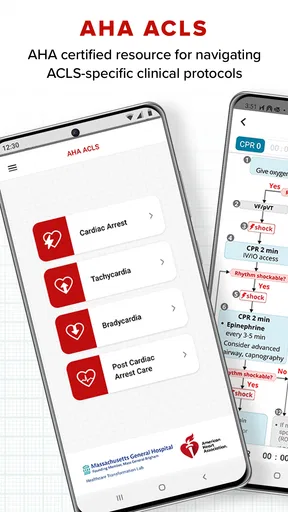
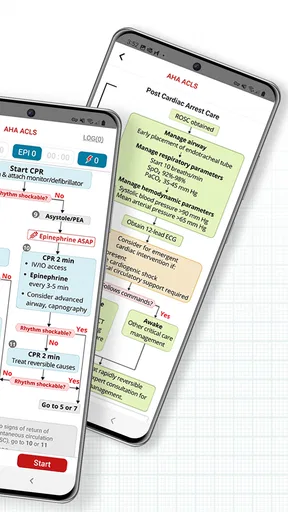
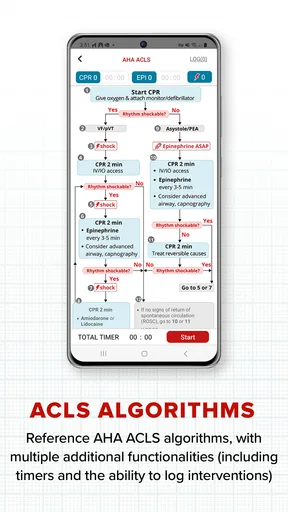
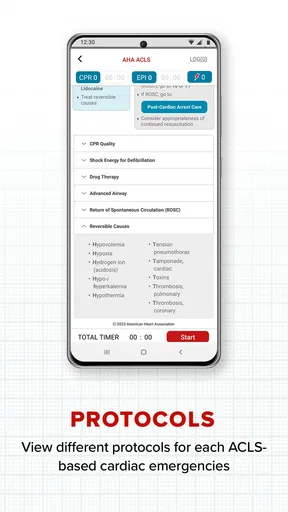
The app is packed with features that cater to both novices and experienced practitioners. One of my favorite features is the comprehensive library of algorithms and protocols. These are essential for anyone who needs to stay updated with the latest in advanced cardiac life support. Each algorithm is detailed and easy to follow, making it simple to understand complex procedures.
The interactive quizzes and practice tests are another highlight. They’re designed to reinforce your understanding and ensure you’re ready for any real-life scenario. I found these particularly helpful in assessing my knowledge gaps and areas where I needed more practice.
Learning On the Go
One of the coolest things about the app is its offline access. Yes, you heard that right. You can download the content and study on the go without worrying about internet connectivity. Perfect for those moments when you're commuting or just chilling in a place with spotty Wi-Fi.
Moreover, the app offers a personalized learning experience. You can track your progress, set reminders for study sessions, and even bookmark sections you want to revisit later. This level of customization makes the learning process much more engaging and efficient.
Real-World Application
Now, let’s talk about putting what you’ve learned into practice. The app includes a section dedicated to case scenarios, which simulate real-world emergencies. These are invaluable for honing decision-making skills in high-pressure situations. I found myself really engaged with these scenarios, as they provided a safe space to test and apply my knowledge.
It’s also worth mentioning the app’s ability to connect you with a community of users. Through forums and discussion boards, you can share experiences, ask questions, and learn from others. This sense of community adds a social element to what might otherwise be a solitary learning experience.
Why This ACLS Reference May Suit You
So, why choose this app? Well, in addition to its comprehensive content and interactive features, the app is regularly updated with the latest guidelines and best practices. This ensures you’re always learning the most current and effective techniques.
Plus, the app is backed by the American Heart Association, which gives it a level of authority and credibility that’s hard to beat. Knowing that the information I’m studying is reliable and up-to-date gives me peace of mind.
In conclusion, whether you’re a medical professional or just someone passionate about learning life-saving skills, this app is a fantastic resource. It’s engaging, informative, and accessible, making it a must-have for anyone looking to improve their knowledge and skills in advanced cardiac life support. So, why not give it a try and see how it can enhance your learning journey?
Verdict
Strengths of AHA ACLS
- Comprehensive training modules.
- User-friendly interface design.
- High-quality video tutorials.
- Offline access available.
- Regular content updates.
Limitations of AHA ACLS
- Limited free content.
- Requires stable internet for updates.
- Occasional app crashes.
- High subscription cost.
- Limited language support.
Similar Picks in This Category
View All
WebMD: Symptom Checker
WebMD, LLC4.1

Microphone Amplifier
DOSA Apps4.2

Anatomy Learning - 3D Anatomy
3D Medical OU4.5

Period Tracker and Calendar
SimpleInnovation4.9

GoodRx: Prescription Coupons
GoodRx4.8

CVS Health
CVS Pharmacy4.5
Frequently Asked Questions
What is the main purpose of the AHA ACLS app?
The AHA ACLS app is designed to provide healthcare professionals with essential resources for Advanced Cardiovascular Life Support (ACLS) training. It offers interactive tools, guidelines, and algorithms to enhance learning and proficiency in emergency cardiovascular care, making it a valuable companion for both training and real-world scenarios.
Is the AHA ACLS app suitable for beginners?
While the AHA ACLS app is primarily aimed at healthcare professionals who already have basic knowledge of life support, it can be a beneficial resource for beginners as well. The app includes detailed guidelines and educational content that can aid in understanding ACLS protocols, but prior foundational knowledge is recommended.
Does the AHA ACLS app require an internet connection?
The AHA ACLS app offers both online and offline functionalities. While some features, such as updates and certain interactive components, require an internet connection, the core guidelines and algorithms can be accessed offline, making it convenient for use in environments where connectivity is limited.
How frequently is the content in the AHA ACLS app updated?
The AHA ACLS app is regularly updated to reflect the latest American Heart Association guidelines and protocols. Users can expect updates to be implemented following major AHA review cycles, ensuring that the information remains current and reliable for clinical use and training purposes.
Are there any additional costs associated with the AHA ACLS app?
The AHA ACLS app may have an initial purchase cost, and some features or updates could involve additional in-app purchases. It is important for users to review the pricing details on the app store to understand any potential costs associated with accessing premium content or future updates.
